Five Nights at Freddy’s: The Fourth Closet by Scott Cawthon & Kira Breed-Wrisley
Book series Five Nights at Freddy’s still leaves quite a mixed impression. The mediocre Silver Eyes was followed by the frankly weak The Twisted Ones. With that mindset I approached The Fourth Closet — the final novel of the main trilogy, which, unlike the previous books, carries an 18+ label.
Plot
Some time passes after the events of The Twisted Ones. John still cannot shake off the nightmares of watching Charlie die inside an animatronic. But… Charlie is alive! John refuses to believe it — after all, he clearly remembers her death. When he meets the girl again, he can’t help noticing the oddities in her behavior.
Meanwhile, several children go missing in town, and someone attacks (and nearly kills) Sheriff Burke. John believes this is connected to the strange “return of Charlie.” Together with his friends, he tries to understand: if this girl isn’t Charlie, then who is she? And more importantly — why pretend to be Charlie?
Story Development
The Fourth Closet is fairly compact — around 350 pages. Like its predecessors, the novel is divided into short chapters that rapidly shift locations and narrative threads, giving the story a dynamic pace. Overall, the book is easy to read, though the authors occasionally slip into overwriting, and the animatronic-related scenes are sometimes overloaded with technical detail that breaks the rhythm. Still, compared to the previous entries, The Fourth Closet has noticeably more action.
The book tries hard to preserve the spirit of the game, yet the classic “five nights structure,” already shaky in the previous novel, is now completely abandoned. The plot twists are somewhat predictable, but they provide a logical conclusion to the trilogy and answer most of the lingering questions.
Atmosphere
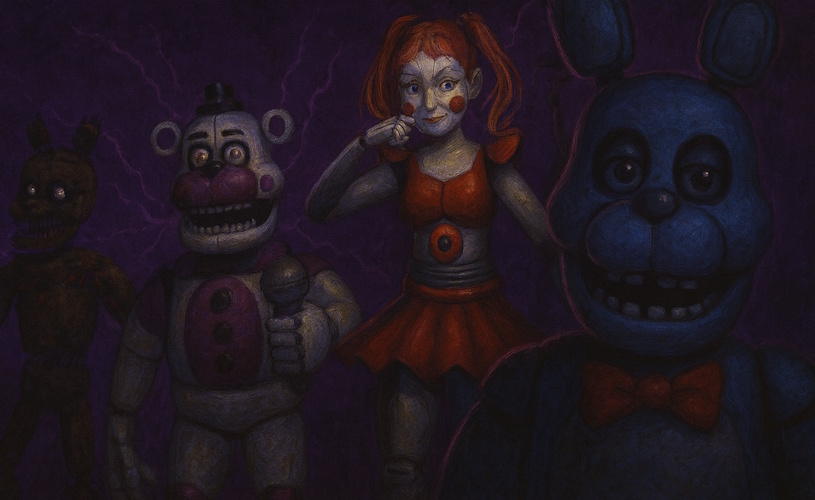
Among the book’s distinctive features are new locations: besides familiar Hurricane, readers will visit a new pizzeria (Circus Baby’s Pizza), encounter a mirror maze, and meet a sinister clown animatronic. William Afton also returns (albeit briefly). Overall, the atmosphere-building work aimed at the fan base is done quite well.
The book maintains the series’ traditional ominous tone. The authors experiment with perception, and remembering the hallucinatory chaos of The Twisted Ones, the reader once again cannot fully trust what’s happening. Here — unlike in the previous installment — this approach actually works.
Though at times the atmosphere cracks under the weight of excessive technical explanations.
Characters
The final part brings back all the familiar faces: John, Charlie, Jessica, Marla, and Carlton. Sheriff Clay, though sidelined after being injured, still sets the investigative tone. William Afton acts as an invisible puppeteer, and even Aunt Jen makes a brief appearance. The only absence is Archie, who was oddly overemphasized in The Twisted Ones. I still don’t understand why that character received so much attention earlier.
The main strength of the book, character-wise, is that we finally get an answer to what is truly wrong with Charlie. The final twist, though expected, allows the reader to re-evaluate her behavior in a new light. Suddenly, irritation gives way to at least some understanding.
How It Differs from the Other Books
The Fourth Closet shifts the narrative focus significantly. While the previous novels were tangled up in the past, this one moves into the present. There is more crime-driven detective work and an active storyline about kidnapped children, rather than just exploring abandoned locations and ghosts of the past.
Structurally, the novel is clearer and more linear: most answers appear during the story itself. Unlike The Silver Eyes and The Twisted Ones, there are no endless returns to Freddy’s backstory — the plot moves forward thanks to new conflicts.
Stylistically, The Fourth Closet leans into sci-fi horror (avoiding heavy spoilers), while the earlier books were closer to traditional supernatural horror. As a result, the atmosphere is more dynamic, featuring surprises like talking toys and deadly animatronics roaming the streets. Overall, the final book feels less predictable and more layered: the core intrigue revolves around Charlie’s identity rather than the ghosts of the past.
Big Idea
Much like in The Twisted Ones, one of the story’s strongest aspects is its idea (the difference being that in The Twisted Ones it was almost the only strong part).
The novel explores what limitless parental love and grief can ultimately drive a person to do. Once the true purpose of that fourth closet becomes clear, the reader is struck by the depth and sincerity of a grief-stricken person’s emotions.
The book touches on several other themes as well, but they all ultimately circle back to the main one — accepting death, both: one’s own and that of loved ones.
Conclusion
As a whole, the novel is far more engaging than the previous one (which, admittedly, wasn’t a particularly high bar). It reads easily, ties together all three books into a cohesive narrative, and delivers a surprisingly strong idea payload (even if that’s not the most crucial element in horror). At the same time, it retains the usual flaws of the series: bouts of overwriting and an overload of technical details.
Still, if you’ve read the first two books, I see no reason not to pick up the third.