
Don’t trust yourself! (Survive the Night by Riley Sager)
I came across this book (and this author) by pure chance, after noticing the novel The House Across the Lake. Some time ago, I had seen a movie with a very similar title (starring the wonderful Rebecca Hall) and assumed it was based on that book. Turned out it wasn’t. Still, that’s how I discovered Riley Sager — and found out that he already had eight novels published. So off I went to the bookstore and picked up the first six at once (they were sold in bundles of three). For my starting point, I chose Survive the Night, as it looked like the “lightest” of the bunch.
Plot
Year 1991. College student Charlie Jordan is shaken by a tragedy — several months earlier, her friend and dorm roommate was murdered by a serial killer nicknamed the Campus Killer. Charlie only saw the possible murderer from behind, so she can’t recall anything useful for the police. Guilt, exhaustion, and fear are compounded by intrusive visions in which reality is replaced by “movies in her head.”
Deciding to leave college early and return home, Charlie posts a ride-share notice on the bulletin board in the student center. A guy named Josh responds — polite, calm, a little odd. But as the night deepens and the road stretches on, Charlie begins to suspect that Josh might be the very serial killer everyone is hunting. Or is she just imagining things?
Plot Development
The novel unfolds over the course of a single night, which gives the narrative a compressed, cinematic tension. Everything is filtered through Charlie’s perception — a protagonist who isn’t just an unreliable narrator, but rather someone who struggles to trust even herself. This is an interesting choice: making the main character slightly detached from reality, blurring the line between what’s real and what’s imagined. The problem is that this gimmick loses its weight closer to the finale and ultimately has little impact on the outcome.
Sager doesn’t overload the text with unnecessary descriptions — everything is aimed at building atmospheric pressure. But at a certain point, there’s simply too much of it. By the middle of the book, it starts to feel like Sager is grinding the same theme over and over, padding out page count to turn a decent novella into a rather mediocre novel.
As a result, both in terms of atmosphere and pacing, the middle section completely collapses. The story just doesn’t have enough substance to sustain this volume.
Atmosphere
Stylistically and atmospherically, Sager tries to construct a tense game of cat and mouse, where no one tells the whole truth and reality itself may be nothing more than a construct of a tired, traumatized mind. In theory, this is genuinely interesting — even gripping at times.
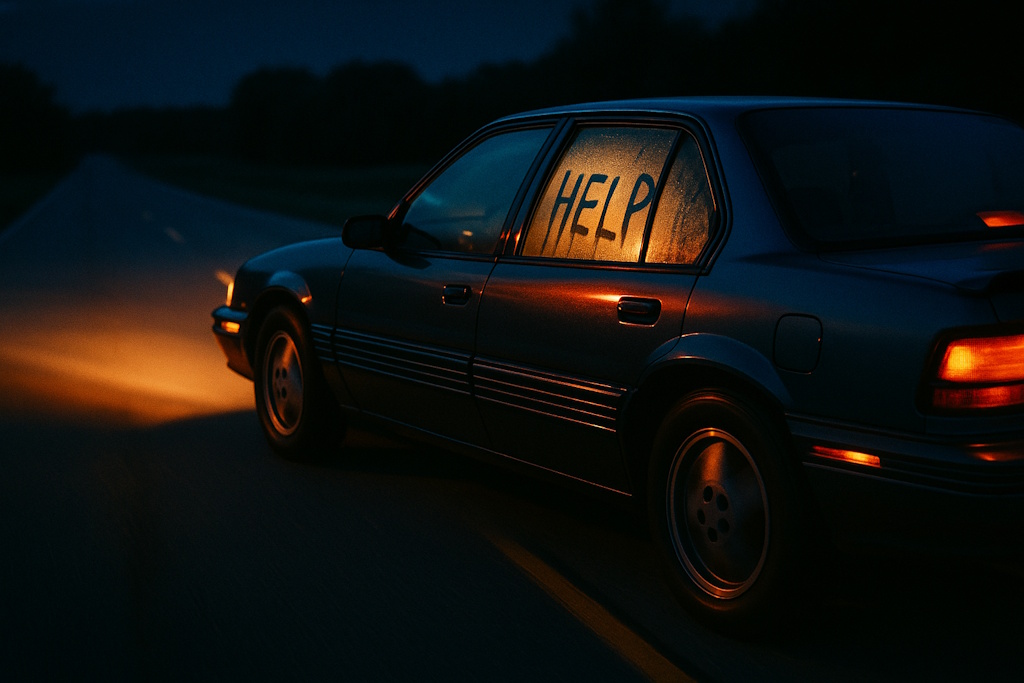
On top of that, Sager writes simply and very cinematically, staging scenes as if through a camera lens: angles, details, shadows on faces, breath fogging up glass. He deliberately plays with horror and thriller clichés — the mysterious hitchhiker, the night road, abandoned gas stations, all the classic “red flags” signaling that something is wrong. But instead of merely reproducing them, he reframes these tropes through the heroine’s perception.
Despite multiple locations appearing in the narrative, Survive the Night is largely written as a “closed-space” story. The action barely escapes the confines of a single car, a single night, a single long conversation between two people. This creates an intense, claustrophobic experience where every line of dialogue matters.
And perhaps most importantly, the book is quite easy to read. In the right mood, you can finish Survive the Night in an evening or two.
Characters
As for the characters — this is where things get shaky. Charlie, the protagonist, doesn’t inspire much sympathy. Despite her trauma, she consciously refuses treatment for her neuroses and chooses to run away from her problems instead of dealing with them.
Robbie, Charlie’s boyfriend — whom she considers leaving because he’s “too good” for her — lacks logic entirely (especially since he’s partially responsible for much of what happens in the story). The final twist involving him evokes little more than a smile, as it completely contradicts the events of the book (or, alternatively, Charlie really is that naive and inattentive, which is also quite possible).
Josh, whose guilt Charlie is so desperately trying to prove, isn’t particularly bright either. This becomes clear about a third of the way through the book, when he starts contradicting his own stories, raising more and more suspicion.
And then there’s Marge — arguably the most interesting character, who appears after the story passes its halfway point. Yes, she causes serious trouble, but it’s hard to blame her: she has a rock-solid motivation (unlike most of the other characters).
Finale
After an incredibly drawn-out and tedious second act, the book barrels straight into the finale. On the plus side, the reader gets answers to all the questions that may have arisen during the reading. On the downside, most of those answers are either obvious or simply don’t align with the story (that aforementioned twist involving Robbie). Still, the finale can be called epic in its own way — at the very least, it has some spark.
Big Idea
If we try to extract any thematic substance, it’s a familiar one for stories like this: coming to terms with what has happened. Charlie is fragile, overwhelmed by guilt, prone to self-blame, yet simultaneously searching for meaning. Her hyper-visual imagination — the “movies in her head” — isn’t just a stylistic device, but a reflection of trauma and isolation.
This leads to another interesting idea: what’s more dangerous — a real killer or one’s own fears? Sager pushes the reader to question how much we trust ourselves, and how much we trust what we see.
The Author
A few words about the author himself. Riley Sager is the pen name of American writer Todd Ritter, who under this alias churns out a thriller almost every year. Such productivity hasn’t gone unnoticed: his books have been published in more than three dozen countries, with total sales exceeding three million copies. Two film adaptations are also in the works: Universal has picked up Final Girls, while Netflix is developing an adaptation of The House Across the Lake.
Conclusion
In the end, Survive the Night is a dynamic psychological thriller that keeps you on edge… but doesn’t always convince. At times cinematic and atmospheric, at times dull and overextended. The story isn’t strong enough to fill the entire book, but it’s an easy read. From me, a solid “good” — and as an introduction to a new author, even an “excellent.”