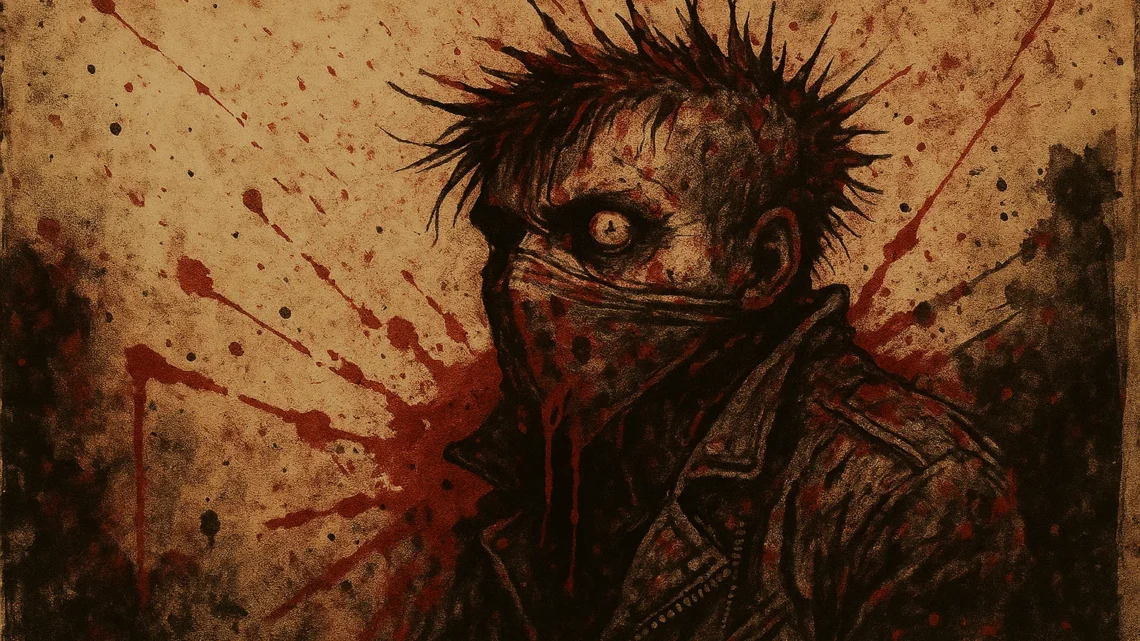
What is Splatterpunk: An Introduction to Horror’s Bloodiest Subgenre
The world of horror is varied: from mysterious Gothic dread to slow-building psychological tension. But if you’re looking for a genre that leaves no room for hints, veils, or half-shadows — meet His Majesty, Splatterpunk. This is horror in its most terrifying manifestation: reality. It’s a challenge, a protest, aggression and ruthless candor — often doused with a bucket (or several) of blood.
Splatterpunk is a subgenre of horror that emerged in the 1980s, characterized by an extreme naturalism in the depiction of violence, bodily horror, and degradation. The term comes from the English words splatter (splash, bloody mess) and punk — not only as a musical movement, but as a spirit of resistance and rebellion. Splatterpunk is horror with the brakes off: often provocative, amoral, and shocking.
Many writers in the field have insisted that splatterpunk is more than a collection of bloody scenes. It is a form of expressing anger, social discontent, and pain. It arose as an alternative to the “sterile” horror of the era, in which evil was often veiled. Splatterpunk preferred to show evil as it is — with guts, filth, screams and agony.
The genre divides readers: for some it’s the low point of literature, for others a challenge. Today we’ll take a close look at what splatterpunk is, where it came from, which books and films represent it, who writes it, and why it continues to spark debate and fascination decades on.
Ready to dive into the meat grinder? Then let’s go!
History of Splatterpunk: From Punk to Bookstores
To understand splatterpunk, you need to go back to the turbulent 1980s. It was a time of change: the Cold War, rising violence in the news, a decline of faith in traditional institutions, and the flourishing of counterculture. In horror fiction, more and more voices felt cramped by the confines of “civilized” horror. Against the popularity of Stephen King — who scared readers but remained within the mainstream — a new style was forming: sharp, aggressive, painfully honest.
The term “splatterpunk” was first used in 1986 by writer David J. Schow, who himself wrote stories with excessive levels of violence and naturalism. The word quickly caught on. Splatterpunk became less a strict literary category and more a movement against censorship, decorum, and literary conventions.
Inspired by punk aesthetics (musical and cultural), splatterpunk proclaimed: enough with innuendo, enough with veiled fears — evil should not be romanticized; it should be turned inside out — in guts, blood, torture, rape, decay and moral degradation. What other genres only hint at, splatterpunk demonstrates in detail.
During this period the first major authors of the movement appeared, such as Barker, Ketchum and Laymon.
Works were circulated through small presses, fanzines, and underground anthologies. Some books were banned, provoked scandals and heated debates — which only fueled interest in the genre.
Splatterpunk as Protest
It’s important to understand: splatterpunk is not just “bloody trash.” Its roots lie in social revolt. These texts were written by people who had something to say — about corruption, violence, war, perversions of power, taboos and hypocrisy. The genre became a form of literary punk rock, in which guitar riffs were replaced by descriptions of a person slowly losing their skin under acid.
From the mid-1990s splatterpunk receded somewhat into the shadows, but it left a mark and expanded the boundaries of what was permissible in horror fiction.
Key Features of Splatterpunk
Splatterpunk is often confused with other extreme directions of horror — slasher or body horror. But splatterpunk is not simply “very bloody horror.” The subgenre has its own philosophy, aesthetics and aims. It differs from other horror styles both in form and intent.
Below are the key features of splatterpunk to help distinguish it from similar formats.
Graphic, naturalistic violence
The main feature of splatterpunk is the frank depiction of violence. Blood, dismemberment, rape, entrails, decomposing corpses — all described in the utmost detail. There is no “off-screen” here — on the contrary, emphasis is placed precisely on what makes you want to look away.
Taboos and social provocation
Splatterpunk often deliberately violates social taboos: violence (including sexual violence, often used to make an accusatory point), cannibalism, incest, and other horrific manifestations.
However, this is not shock for shock’s sake but a form of harsh critique of society, its moral limits and hypocrisy. For authors it’s a way to jolt the reader and force them to look at the unpleasant side of reality. At the same time, splatterpunk is frequently criticized for “exploiting horror” — the line between art and excess is razor-thin. And it is precisely on that edge that the genre exists.
Punk philosophy
The “punk” in the name is no accident. The genre grew out of the countercultural spirit of the 1980s. Its main themes:
- rebellion against authority
- distrust of the system
- rage at social institutions
- moral decay
- protest against censorship
Splatterpunk protagonists are often antiheroes: society’s outcasts, criminals, madmen, perverts. Through their perspective the author reveals a society that is hypocritical, brutal and broken. Splatterpunk says: look — here is what you don’t want to see — and it really exists.
The genre is steeped in anti-authoritarian, countercultural aesthetics. Characters are often marginalized, mentally unstable, living outside the law or fighting the system. The world is cruel, corrupt and rotten; hope is almost unattainable.
A rejection of traditional “fear”
What is the main rule of “classic” horror? To scare by what is not shown — what the reader imagines. Splatterpunk rejects traditional elements of suspense such as mysterious noises, shadows, the waiting-for-an-attack, the unknown, and so on.
Splatterpunk’s task is not to keep the reader in fear but to attack them suddenly, roughly and as cruelly as possible. It’s shock therapy: not a game with emotions, but a blow to the nerves. Readers are not frightened by the possibility of death — they are forced to experience it with the characters, to feel every detail.
In other words, splatterpunk does not frighten “in the dark”; it does not build atmosphere using mysticism or suspense. Instead, it mounts a frontal assault on the senses — disgust, rage and shock.
No morality and no salvation
Classic horror often ends with a moral: evil punished, heroes saved. Splatterpunk often leaves the reader in the dirt and blood, with no way out. It’s a genre without consolation, without a “happy ending,” where things can finish even worse than they began.
Evil is not punished, justice does not come, and survivors do not necessarily become better. Don’t be surprised if:
- the most repulsive characters survive
- innocents die, often in terrible ways
- there is no moral, and no hope
This is a genre in which the most horrifying and perverted variations of reality are presented without filters. There are no illusions — and that is its terrifying power.
How Splatterpunk Differs from Other Genres
As mentioned earlier, splatterpunk is often confused with slashers or body horror. Despite shared traits, the genres differ.
Take slashers: at first glance the genres look similar — both include murders, blood, and victims. But the slasher follows a formula. Typically, a killer hunts a group of teens, and the tension is built around who will survive and how the next character will be killed. Violence in slashers is vivid but often stylized, sometimes presented with elements of playfulness or even humor. Splatterpunk, by contrast, follows no templates. Murders here are not mere set dressing or a plot device but a central theme. Violence is presented naturalistically, brutally, with no relief for the reader. There will be no “final girl” who triumphantly defeats evil. Often there is more evil than heroes, and it frequently goes unpunished.
Body horror focuses on bodily alteration and deformation — via disease, mutation, parasites, transformation. It evokes fear from the loss of control over one’s physical self. This is horror of internal destruction — often with philosophical undertones (a notable example of the genre is Nick Cutter’s The Troop).
Splatterpunk also deals with physicality, but in a different key. The body is an object of destruction, torture and murder. There are no fantastic transformations — there is the realism of pain. It is not metaphor but a direct demonstration that flesh is vulnerable and violence is inhuman.
Why Splatterpunk Provokes Debate
Since its inception, splatterpunk has been one of the most controversial forms of horror. It divided readers and writers: for some — a necessary and powerful literary weapon; for others — the embodiment of poor taste and gratuitous violence.
The main reason for controversy is the graphic depiction of violence. Unlike traditional horror, splatterpunk is neither veiled nor metaphorical. It shows torture, dismemberment, sexual violence and perversions as they are — with details and without moral filters. Many find this repellent and accuse the genre of exploitation. Critics argue that such an approach devalues human life and can even blunt empathy. The thin line between art and shock for shock’s sake is the subject of intense debate. When violence becomes so explicit, the question always arises: “Why?” Is there meaning, or is it an attempt to provoke and elicit a reaction? And if there is meaning — can an unprepared reader perceive it?
There is also the ethical dimension. Many splatterpunk works touch on taboo topics: pedophilia, incest, necrophilia, cannibalism. Authors claim they do this to expose, to explore the limits of human cruelty. Critics counter that such scenes are not always justified and can harm readers, especially when not framed in a critical context.
Nevertheless, the genre has many defenders. They say: horror must be honest. The world is full of pain, and literature has the right to show it. Moreover, splatterpunk is often the space where things other genres avoid are spoken about.
This is the crux of the debate: where is the line between truth and provocation, art and cruelty?
Notable Splatterpunk Authors and Books
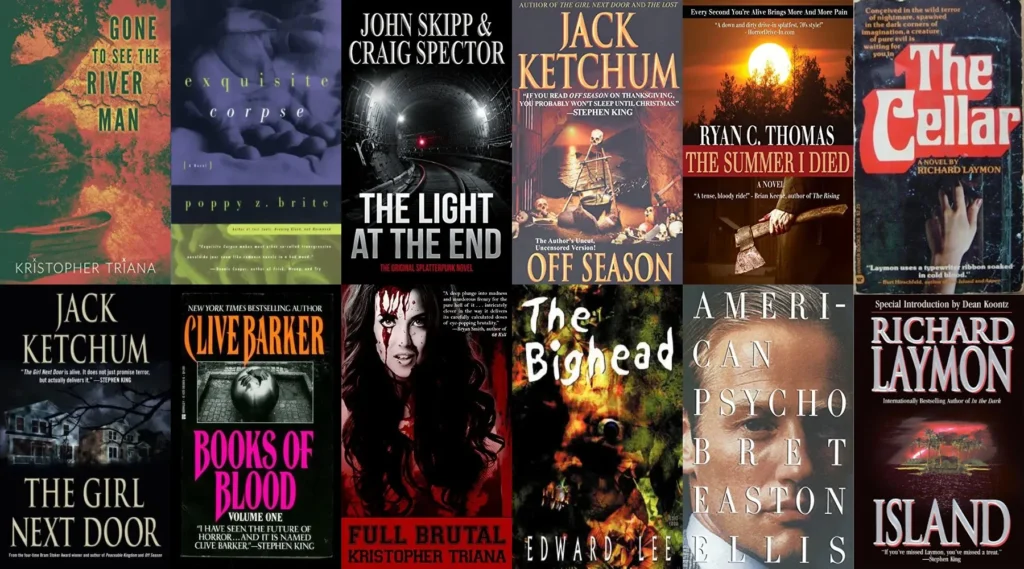
Although splatterpunk never became mainstream, it has produced a number of vivid writers. The genre gave the world memorable authors and cult books that influenced horror as a whole.
Clive Barker
One of the founders and main voices of the genre. His Books of Blood (1984–1985) is considered a true splatterpunk manifesto. Barker blends body horror, explicit brutality and philosophical motifs — he doesn’t just frighten; he makes you think.
Barker himself maintained that fear should be cathartic, and horror honest, even if it’s disgusting. In his works blood and flesh are not mere shock elements but ways to show pain, passion and the inner demons of a person.
Recommended reading:
- Books of Blood — stories with a wide range of motifs: from demonic artists to living walls.
- The Hellbound Heart — the novella that became the basis for the cult film Hellraiser (1987).
Richard Laymon
One of the most prolific and controversial authors of “hard” horror. His novels often combine hyper-visual violence, sexual motifs and a relentless pace. Laymon was criticized for exploiting all kinds of violence, but his books consistently found devoted fans.
Recommended reading:
- The Cellar (1980) — the first novel in the Beast House Chronicles, dark, brutal and thoroughly splatterpunk.
- Island (1995) — a mix of psychological thriller and savage survival.
Edward Lee
If Clive Barker explores flesh-horrors through philosophy, Edward Lee does it through trash, the grotesque and absolute indecency. His novels are pure splatterpunk: maximal concentrations of bodily horror, sexual violence and perverse humor.
Recommended reading:
- The Bighead (1997) — a landmark work that pushes the genre’s traits to the extreme.
- Header (1995) — a short, shocking novella (sometimes called a “novel”) that crosses many lines.
Jack Ketchum
Although hard to classify strictly as splatterpunk, Ketchum had a huge impact on the genre. His prose is realism pushed to extremes. Unlike many colleagues, he writes not about monsters but about people — real monsters.
Recommended reading:
- The Girl Next Door (1989) — based on real events, one of the most brutal and emotionally devastating books in horror.
- Off Season (1981) and Offspring (1991) — about cannibals terrorizing tourists. Harsh, bleak, and almost hopeless.
Contemporary Splatterpunk Authors
Modern writers continue to develop and transform splatterpunk, preserving its core features while adding their own touches: some emphasize psychological depth, others lean into trash, and some pursue literary sophistication.
Ryan Harding
Author of the cult story collection Genital Grinder (2002), Harding is considered one of the most extreme voices in the genre. His work is a concentrate of aggression, pain and moral collapse. Violence in Harding’s stories often mixes bodily horror, sexual perversion and black humor. Yet he avoids meaningless trash: behind the hyperbole is social critique and examination of human nature. Harding frequently collaborates with other extreme horror writers such as Edward Lee and Christopher Rufo.
Kristopher Triana
His novel Full Brutal (2018) became a hit among extreme horror fans. It tells the story of a high-school girl whose moral decay escalates into acts of shocking violence. Triana skillfully mixes teenage drama and psychological portraiture with strong splatterpunk elements. His style combines crude directness with surprising attention to his characters’ inner worlds — especially how trauma and emptiness can turn a person into a monster. Other notable books include Gone to See the River Man, Shepherd of the Black Sheep, and The Ruin Season.
Matthew Stokoe
While not purely a splatterpunk author, Stokoe’s work demonstrates how genre elements can be integrated into complex literary forms. His novels — High Life and Cows — combine naturalistic horror, brutality, social critique and bleak psychological insight. Cows is possibly one of the most repulsive and simultaneously tragic novels in modern literature: a blend of allegory, bodily horror, incest, violence and identity struggle. Stokoe uses splatterpunk as a tool to expose society’s underbelly and reveal the dirty underside of human life.
Current State and Popularity of the Genre
Despite its scandalous reputation, relative marginality and a quiet period in the 2000s, the genre is experiencing a revival. Since the late 2010s interest in splatterpunk has surged, helped by the popularization of extreme horror online and the growth of the self-publishing scene.
A key marker of this resurgence was the founding of the Splatterpunk Awards in 2018 at the major American horror convention KillerCon. These awards are presented annually for the best works in splatterpunk and extreme horror. The jury is composed of recognized authors and critics, and winners often become niche bestsellers. This has not only legitimized the genre but helped pull it out of the underground — at least partly.
Self-publishing communities have played an important role. Platforms like Amazon Kindle Direct Publishing and Smashwords allowed authors to publish without censorship or heavy editorial interference — ideal for splatterpunk, which traditional publishers often refused to back commercially. This created an ecosystem of writers, artists and readers united by a love of brutal, provocative and candid horror. A new wave of popularity also arrived via social networks — especially TikTok and BookTok. Recommendation videos, tags like #extremehorror or #splatterpunk, and lists of “the most disgusting novels you’ve ever read” regularly gather hundreds of thousands of views. Goodreads users create lists titled “So disturbing I wish I could unread it,” with splatterpunk titles frequently at the top.
Thus, today splatterpunk is not just a niche, but a dynamically evolving direction that has found its audience in the digital age — and it doesn’t seem likely to stop.
Should You Read Splatterpunk?
To conclude, an attempt to answer the main question: is it worth reading? Splatterpunk is not for everyone. It shocks, provokes and often repels. Blood, brutality, physiological detail — these are integral to the style. If scenes of violence, sexual perversion, rotting corpses and a complete rejection of taboos are not to your taste — you’re probably better off skipping it. But if you’re looking for literature that challenges limits, explores the boundaries of what’s permissible and asks moral and psychological questions of its reader — splatterpunk can be a surprisingly powerful experience.
Who is it for? Primarily for boundary-seekers. For those who find “soft” horror insufficient and believe true fear is not only the shadow behind the curtain but the rot inside a person. These books are not meant to comfort but to shake. People read them not for pleasure but for catharsis — when through disgust and fear you arrive at some form of cleansing. Sometimes a radical form allows a deeper sense of humanistic content: in filth and pain heroes may show humanity, or lose it entirely.
So, if you’re curious how far horror can go — read it. If you’re not afraid to look into the abyss (and be horrified that the abyss looks back) — read it. And yes — if you start feeling nauseous after a few pages, that’s normal. Splatterpunk is not supposed to be comfortable. It’s supposed to be real.