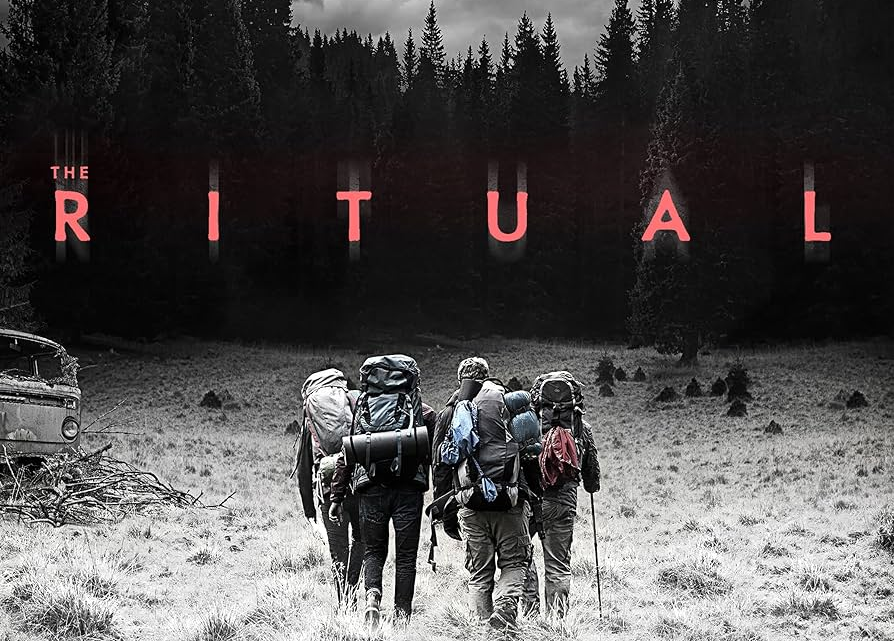
Lost in the Forest (The Ritual by Adam Nevill)
For a couple of years now, I’ve had a small tradition: once a year, I read a book by Adam Nevill. This year, I’m planning to tackle Last Days; last year, it was The House of Small Shadows, and before that, Apartment 16. It all started, of course, with The Ritual, which we’ll discuss today.
Plot
Four old school friends set off on a hike along Sweden’s forests. But one of them, Dom, injures his knee and can’t continue. After a quick discussion, they decide to shorten their route by cutting through the forest. Once inside, they first stumble upon a carcass hanging from a tree, and then find an abandoned cabin where they all have horrific nightmares. Realizing something strange is happening in the forest, they try to escape. But leaving the forest proves much harder than entering it.
Narrative Duality
One of the novel’s major flaws is its split structure: the first part is an eerie, slow-burn survival horror set in the desolate forest, while the second part shifts into a psychological thriller mixed with a slasher, with hints of mysticism as it progresses. This narrative duality doesn’t sit well with everyone.
It feels as though the book was written either by different authors or at very different stages of the author’s life. In fact, there’s a rumor (which I haven’t found proof for, and I haven’t looked very hard) that The Ritual evolved from an earlier novella, Children of the Beast, written by Nevill long before he began publishing under his real name. For those unaware, Adam Nevill used to write adult novels under the pseudonym Lindsay Gordon, which you can still find on places like Amazon.
Structure
What I enjoyed most about The Ritual was its structure. The novel is divided into 69 short sub-chapters across 450 pages, averaging about 6.5 pages per sub-chapter, making it a comfortable read. Nevill uses cliffhangers to keep readers hooked—you finish one page and think, “I’ll just read the next one,” and soon you’re halfway through the book in a single day. This technique reminded me a lot of Stephen King, who also frequently uses short sub-chapters to break up his stories.
Atmosphere
The novel quickly immerses readers in a slow, creeping horror atmosphere. The fear isn’t in what you see but in what you don’t see. Huge carcasses of animals hanging from trees are scary not for what they are, but for who or what put them there.
The setting—Scandinavian forests with their perpetually gray, rainy skies and impenetrable tree canopies—adds to the unsettling atmosphere.
Honestly, while reading, I pictured everything in shades of gray. The level of detail creates a vivid sense of immersion, which is rare in horror literature.
As for the second part, it’s the exact opposite of the first. The atmosphere shifts from slow and tense to fast-paced, with unhinged characters and a mid-tier slasher plot with mystical elements thrown in. New characters are introduced who, in terms of colorfulness, match or even surpass the ones in the forest. But the abrupt shift in plot and genre is more disappointing than refreshing. While the second part is more dynamic, I enjoyed it less.
Plot Consistency
One reviewer on FantLab wrote, “The plot isn’t groundbreaking, but the execution is excellent,” and I agree. Nevill hasn’t created anything new here; he’s just done a good job telling an old story. The forest horror is some of the best I’ve read, and the slasher part, while average, doesn’t detract from the rest.
Characters
As for the characters, it’s pointless to describe those from the second part in detail—those who read it will understand. Nevill immerses readers in a subculture of fanatics who believe in supernatural forces. To avoid spoilers, I’ll leave it at that.
In the first part, we meet more familiar but nonetheless intriguing characters. At first glance, they seem like well-established men, “masters of their own lives.” But it’s all a facade. The man working in retail, without a business or millions to his name, is arguably the happiest of the bunch. Nevill skillfully contrasts supernatural horrors with the fears of middle-aged men: fear of failure, fear of appearing weak, fear of debt, business collapse, divorce, and losing one’s place in society. Honestly, I don’t know which is scarier.
Film Adaptation
In short, it’s decent and worth a watch. If you haven’t seen it yet, I’d say go for it. But be warned—the key line, “We’re here because of you,” has a very different meaning in the film.
Conclusion
The Ritual is a solid horror novel that does what it’s supposed to do: it frightens some with its forest atmosphere, others with its deranged characters and mythical creatures, and still others with its depiction of debts, social pressures, and societal expectations.
Less than a year has passed since I read The House of Small Shadows, yet that book has almost completely faded from memory (thank goodness for notes). I read The Ritual three years ago, in May 2017, and I still vividly remember almost every scene… which, to me, says something.