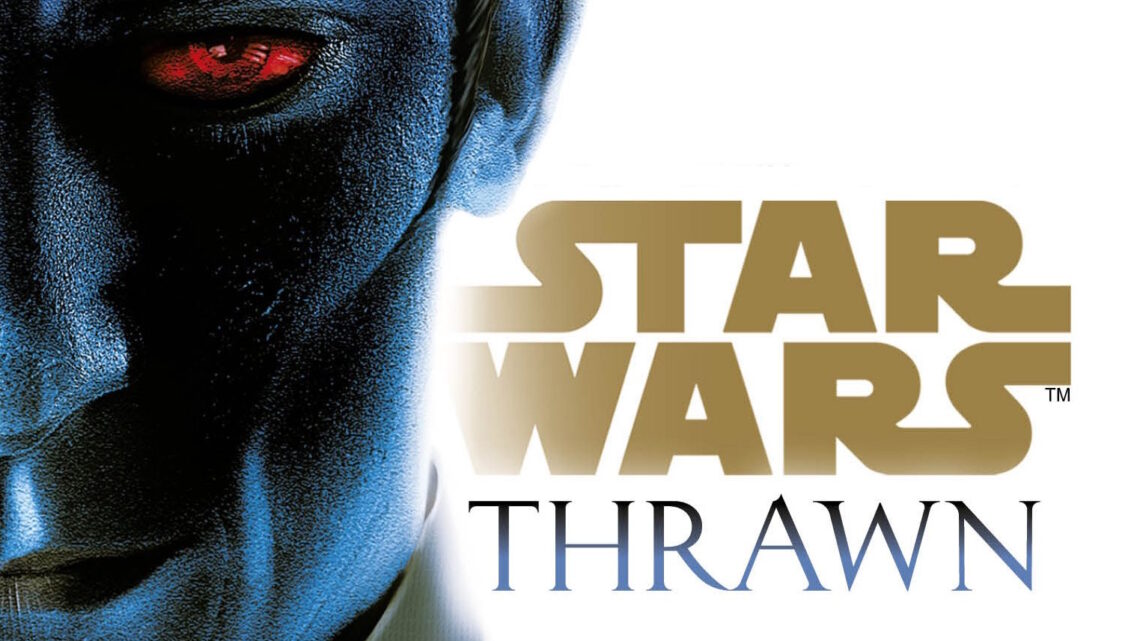
Thrawn by Timothy Zahn
Thrawn by Timothy Zahn is, at this point, perhaps the best novel (excluding film novelizations) of the new Star Wars canon — at least if you trust the ratings. And it makes sense: this is where one of the brightest characters of the former Legends continuity (the Expanded Universe that Disney de-canonized) is officially introduced back into the story.
Plot
An Imperial patrol on one of the Outer Rim planets bordering the Unknown Regions encounters an outsider — a Chiss. He proves quick and resourceful enough to take down a squad of stormtroopers (though really, who hasn’t done that by now?), which impresses the commanding officer of the ship. The Chiss, whose name turns out to be Mitth’raw’nuruodo — or just Thrawn — is brought before the Emperor, who, surprise, already knows about him through Darth Vader. The Emperor decides to send the alien to the Imperial Academy. Thus begins Thrawn’s journey in service of the Empire, during which he rises from cadet to Grand Admiral.
Meanwhile, on distant Lothal, due to corruption, the family of Arihnda Pryce loses its business. Frustrated and seeking any chance to survive, Pryce turns to government service…
So, the book tells the parallel stories of two characters: the future Governor of Lothal, Arihnda Pryce, and Grand Admiral Thrawn himself — whose achievements in service to the Empire are apparently so significant that they are never mentioned in any of the films (yes, both of them appear in the animated series Star Wars: Rebels, which is… at least something, I guess).
Where to Start with the Critique?
Let’s begin with the slightly annoying fact that the events of the book affect absolutely nothing. At all. And they bring nothing fundamentally new to the Star Wars universe.
Same time, the novel itself should answer two main questions:
- Who exactly is Thrawn?
- And why should we care?

However, it successfully avoids answering either of these. Ironically, in the “Thrawn” book almost every major character is more developed than Thrawn .
The secondary characters — Arihnda Pryce and Eli Vanto — are well-written. Their motivations and development are clear and understandable.
But where Thrawn’s intelligence and cunning come from is never explained — beyond the magical phrase “that’s how it is in the Chiss legends.” If in doubt, just say “Chiss heritage” and move on. Which is rather disappointing, considering this is the first Thrawn book in the new canon. Is Disney subtly suggesting we go read Legends instead (like the non-canon Outbound Flight)?
As a character, Thrawn comes across as a mix of Spock (mostly) and John Wick (to a lesser extent). That’s basically it: he’s smart, logical, and can beat you up if needed. Yes, toward the end he partially clarifies his true goal — but since the book has no actual impact on anything, it’s unclear whether he succeeded or not.
Familiar characters appear — Darth Vader, Emperor Palpatine, Grand Moff Tarkin — but the narrative has zero effect on them. They serve mostly as expensive, iconic background props.
About the Plot Everyone Praises
Zahn’s task here was essentially to “fit Thrawn into canon,” even though the updated timeline had no space prepared for him until Rebels aired in 2016. That likely explains why the novel spans such broad time periods, jumping rapidly from one of Thrawn’s mini-victories to another. There is enough material here not just for a novel, but for an entire trilogy. Yes, there is an overarching antagonist — “Night Swan” — but this thread only becomes clear in the second half of the book.
Another Small Problem…
The book has no Star Wars in it. At all.
If you moved this story into a completely different universe, nothing would change. Actually, it might even work better. In Thrawn we see “good Imperial officers” (like Eli Vanto, a small-town guy who just wanted a quiet life), fighting crime and corruption, defending principles and order. Inside the Empire we see social dynamics, politics, small business — not the oppressive war machine we know from Star Wars. This clashes entirely with the franchise’s core moral frame, where the Empire = evil and the Rebellion = good. Instead, this feels closer to the peaceful, diplomatic tone of Star Trek.
It seems like when Zahn submitted the book, Disney’s editors said a firm “nope,” and the final ~50 pages were heavily reworked to force the story back into Star Wars moral structure:
- The Empire must be corrupt and oppressive → Pryce steadily goes insane.
- The “good” characters (Thrawn and Vanto) are framed as not truly aligned with the Empire in their hearts.
However, those last 50 pages cannot overwrite the preceding 400.
Final Thoughts
Despite all that, Thrawn is very much a fan-oriented novel. A person unfamiliar with Star Wars likely wouldn’t understand half of it. The book assumes prior knowledge of basic lore — who the Empire is, who Vader is, why people fear Tarkin, etc. Without that context, the plot becomes full of black holes.
Yet the book itself isn’t bad. The language is simple, the pacing is quick, the action is lively, the space battles are vivid, and the atmosphere works on its own terms. It does not feel like wasted time. But skipping the novel won’t cost even a dedicated fan very much.
Conclusion
Timothy Zahn’s Thrawn is a good, entertaining, fast-paced book. However, it leaves the clear impression that it’s not quite Star Wars — or at least, not the Star Wars we’re accustomed to. But that does not make the novel itself bad.